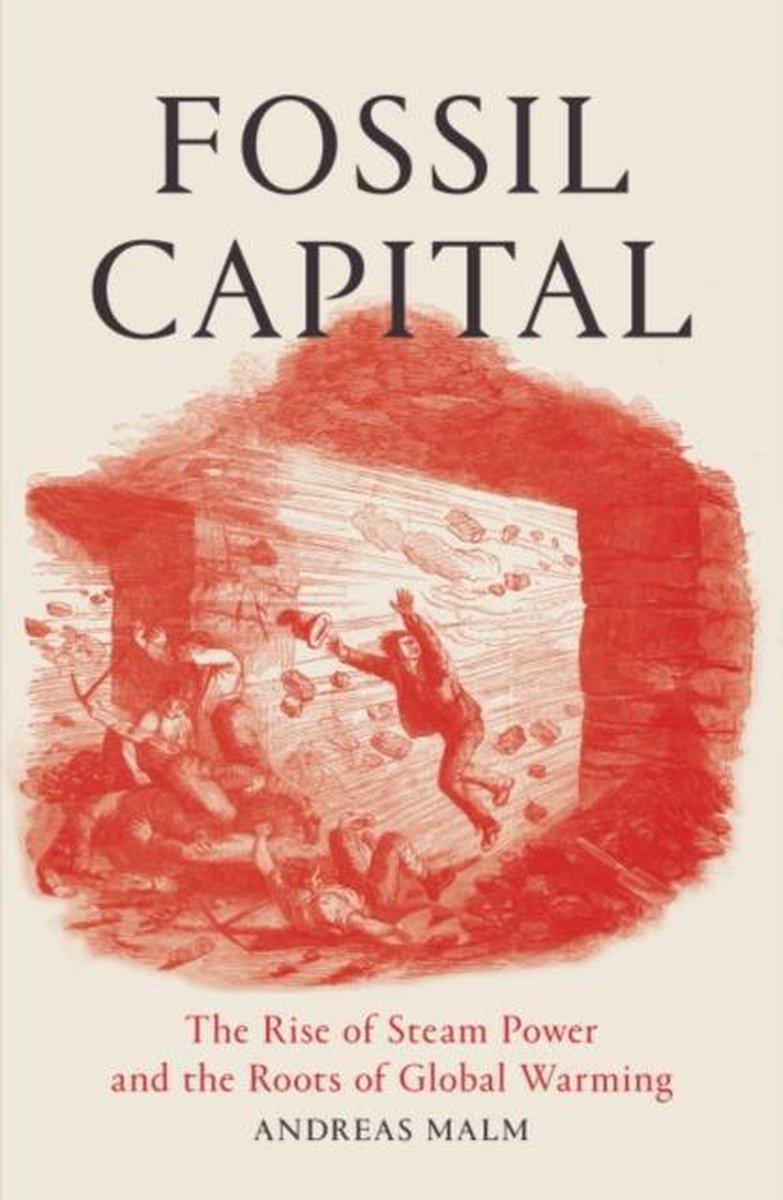

Grigor hat Fossil Capital von Andreas Malm besprochen
CO2 as an effluent of (class) power
4,0 stars
"Fossil Capital" is a pretty well researched book and advances an interesting theses. Namely the that we cannot understand global warming without accounting for the economic and political processes that led us to the current predicament. The author locates the start of this process in 19th century England, where the industrial revolution took place. This would be a pretty standard observation, if it was not supplanted by an economic analysis that doesn't limit itself to simplistic approaches of an economistic nature, but considers an irreducible dimension of class struggle behind the decisions that led to the adoption of coal as a source of energy in the first place. The claim is that despite the great and unused potential of water power, the British capitalists chose coal as an energy source for their factories because it gave them a competitive advantage in terms of class power over an ever more organized …
"Fossil Capital" is a pretty well researched book and advances an interesting theses. Namely the that we cannot understand global warming without accounting for the economic and political processes that led us to the current predicament. The author locates the start of this process in 19th century England, where the industrial revolution took place. This would be a pretty standard observation, if it was not supplanted by an economic analysis that doesn't limit itself to simplistic approaches of an economistic nature, but considers an irreducible dimension of class struggle behind the decisions that led to the adoption of coal as a source of energy in the first place. The claim is that despite the great and unused potential of water power, the British capitalists chose coal as an energy source for their factories because it gave them a competitive advantage in terms of class power over an ever more organized and rebellious working class. Coal offers a specific spatial and temporal profile that allowed it to bypass geographical limitations and meteorological unpredictability, allowing thus the creation of "abstract space" and "abstract time", a spatiotemporality that could be shaped by the demands of capital accumulation and could subsume nature and workers under its own logic. Coal, or more generally fossil capital, thus forms the "energy basis of bourgeois property relations", and it's under these relations that ever growing amounts of CO2 have been and continue to be emitted in the atmosphere.
An interesting critique is the one of the concept of the "Anthropocene", the idea that we have entered a new geological era where humans and their activity have become a geological force. This conception, Malm argues, tends to naturalize climate change and generalize blame for it in the abstract notion of humanity as a whole. Certain authors claim that it goes back to the very discovery of fire, or the combustible nature of the planet itself, and the current rising temperatures would be an expression of such innate properties. To counter this, the author proposes the concept of "Capitalocene", to emphasize that it is not "humanity as a whole" who is to blame for global warming, but a specific social configuration that rose from the chimneys of 19th century Britain and engulfed the whole planet via the process of capital self-valorization.
Malm gives a thorough and detailed history backed by tons of data and references that may bore the reader if they're not particularly interested in this kind of economic history (after all, the book is an adaptation of the author's PhD, so it takes some patience to read). Personally i found the last 4 chapters the most exciting, where the author gives a theoretical account of fossil capital, analyzes the deteriorating current situation and describes the obstacles to a renewables transition (hint: it's the capitalists). It's quite pessimistic about the prospects of a better future, but it is satisfying because it leaves you much more informed as to what a serious climate strategy would look like.
With the precaution that it might require a good amount of determination to go through and to the end, I highly recommend it.